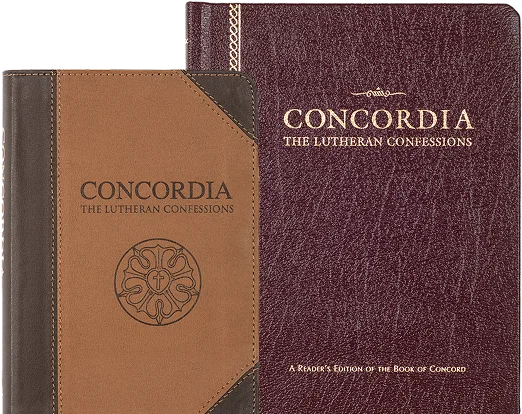

About This Edition
Our text for the Book of Concord is not a brand-new translation from the original German and Latin texts. This reader’s edition is a revised and updated version of the translation originally prepared by William H. T. Dau and G. Friedrich Bente for the Concordia Triglotta, published in 1921.
For years, readers have appreciated the Triglotta translation. But over time it has become less and less readable for a variety of reasons. When Dau and Bente prepared their text, high school and college Latin courses were common. The audience for their English translation was more accustomed to seeing Latin-based terms and the complex sentences preferred in Latin composition. In the past eighty years, Latin instruction has virtually disappeared and English grammatical style has trended toward more simple and direct sentences. In view of these changes, we updated Dau and Bente’s fine translation for modern use.
For example, their translation, closely following Latin and German style, often piled up subordinate clauses in complex sentences. Some of these sentences made up full paragraphs or covered an entire page. We have often simplified these passages by changing the subordinate clauses into independent sentences. Then we started the main clause with therefore, to show the relationship between the sentences. When we could not see a clear method for updating Dau and Bente’s translation, we referred to the German and Latin texts for help in providing a simpler, clearer text.
Where Dau and Bente often used Latin-based words, we have used more common English words, often updating with contemporary meanings in mind. For example, the word remission now means something quite different to the English reader than it did a few generations ago. Today, this term makes us think of cancer and medical treatment instead of God’s mercy. Therefore, throughout the manuscript, we have changed remission to the more familiar word forgiveness.
When the German and Latin texts differed from each other or included unique passages, Dau and Bente inserted the different reading in brackets. We deleted this bracketed material in most cases and focused on providing an English version for either the Latin or the German. Where we did include words or passages from the German 1580 or Latin 1584 edition, we set those words or passages within ‹ ›.